
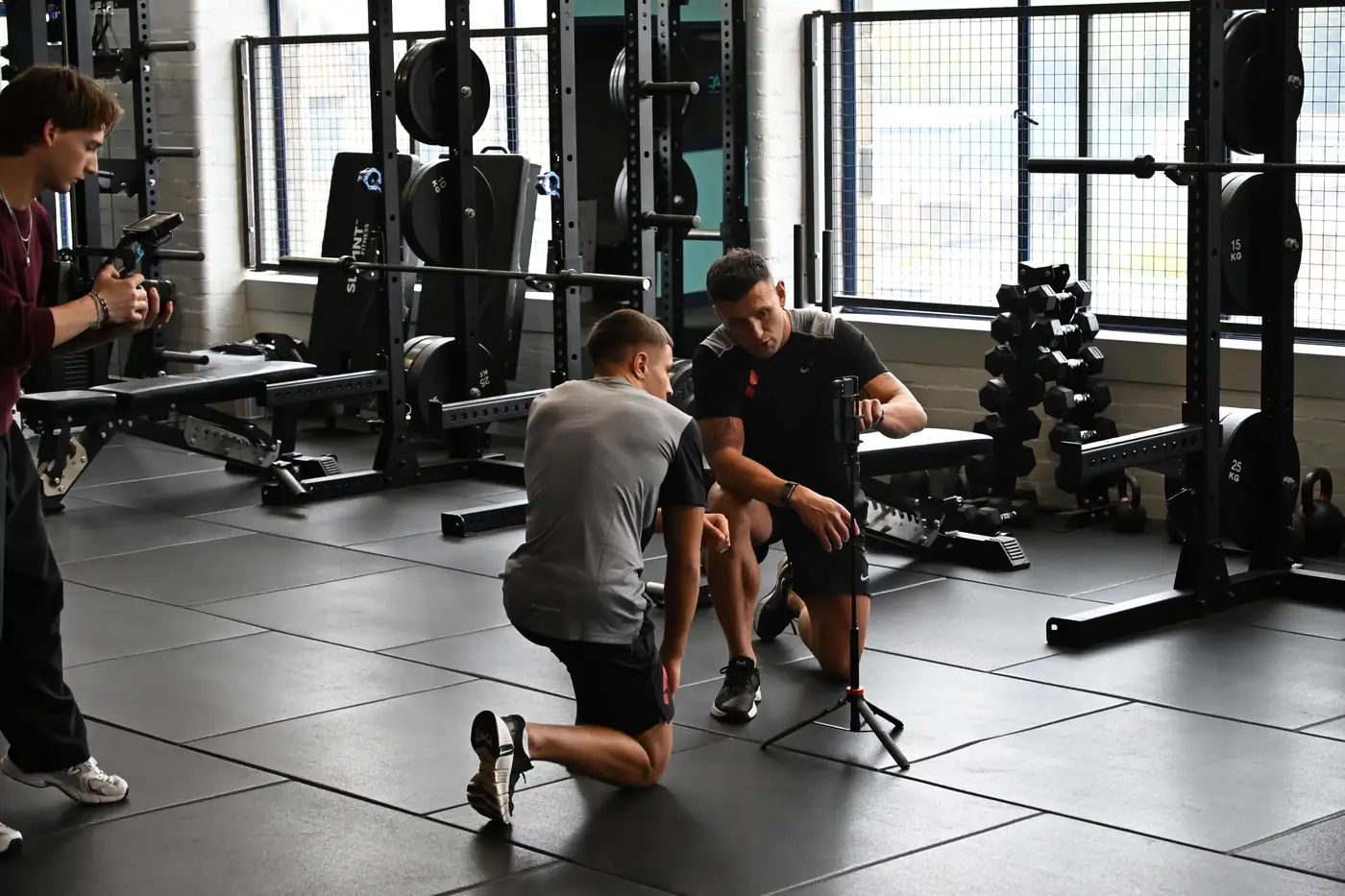
Performing VBT exercises with PeakLines
The six VBT exercises
The six VBT exercises that PeakLines monitors are:
- Power Clean
- Barbell Deadlift
- Hex-bar Deadlift
- Back Squat
- Front Squat
- Bench Press
The correct technique for each exercise is shown in the corresponding videos in the app. To build a profile: collect data across a range of loads (light, moderate, and heavy) and record the best mean velocity for each.
- Each rep should be performed with maximal intent — move as fast as possible.
- Less fatiguing than 1RM testing, but consistent warm-up and rest are important.
- Can guide training within different velocity-based training zones (speed, speed-strength, power, strength-speed, maximal strength).
Five test intervals
Loads are expressed as a percentage of 1 rep max; rep ranges are typical for profiling at each stage.
| Load (% 1RM) | Reps |
|---|---|
| 30% | 2–5 |
| 45% | 2–3 |
| 65% | 1–2 |
| 75% | 1–2 |
| 85% | 1 |
Video guidance: Use the in-app videos for correct set-up and execution for each lift. This page summarises the science and application; movement quality should always follow technical coaching and the demonstrated protocols.
Power Clean
The power clean is one of the most complete athletic development exercises available to a strength and conditioning programme. The power clean trains explosive triple extension of the ankle, knee, and hip under high-velocity load, directly reflecting the neuromuscular demands of sprinting, jumping, and change of direction. Unlike squats and deadlifts, which primarily develop force capacity at lower velocities, the power clean emphasises rapid force expression, making it a key link between gym-based training and athletic performance.
Within a velocity-based training framework, bar velocity (particularly during the second pull) is highly sensitive to neuromuscular readiness, allowing the exercise to function as both a training stimulus and a fatigue monitoring tool.
Compared to the full squat clean, the power clean is received in a partial squat, requiring greater rate of force development to elevate the bar to the catch position. This increases its emphasis on explosive power while reducing dependence on mobility, making it the preferred variation in most athletic development settings.
Overview of the movement
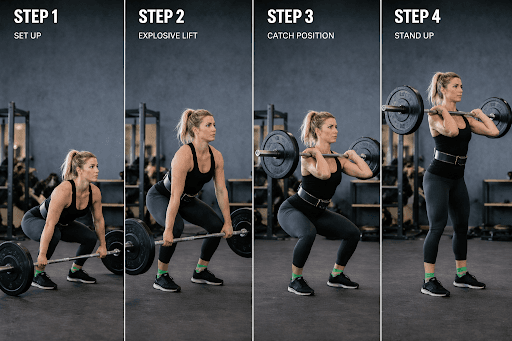
The power clean is performed in three phases. The first pull moves the bar from the floor to above the knee in a controlled, strength-dominant action. The second pull is the explosive phase, where rapid extension of the ankle, knee, and hip generates bar velocity. The catch involves pulling under the bar and receiving it on the shoulders in a partial squat, requiring rapid upper-body coordination and stability.
Sports where the power clean is most relevant
The power clean transfers most effectively to sports requiring explosive triple extension under load. It is highly relevant in:
- Rugby & American football: Acceleration and collision-based actions
- Sprinting & athletics: High-velocity hip extension and force application
- Basketball & volleyball: Repeated jumping and rapid directional change
- Rowing: Explosive drive phase from a flexed start position
- Combat sports: Hip-driven throws and positional transitions
- Throwing events: Whole-body force production from a hip-dominant base
Across these sports, performance is closely linked to the ability to generate force rapidly through coordinated triple extension.
How the power clean develops athletic performance
Rate of force development (RFD): The second pull is completed in <200 ms, requiring rapid motor unit recruitment and high-rate force production, directly underpinning explosive actions such as sprinting, jumping, and contact.
Triple extension power: Simultaneous ankle, knee, and hip extension under load at high velocity reflects the primary motor pattern of explosive movement, training coordination and timing not developed by slower lifts.
Proximal-to-distal sequencing: Force is generated at the hips and transferred through the trunk to the upper body, improving whole-body coordination and enhancing performance in jumping, sprinting, and throwing.
How training can improve your power clean
For a trained athlete, a focused 8-week power clean block can realistically produce 5–10% improvement in 1RM and 0.05–0.15 m/s improvement in MPV at 75% 1RM, with less trained athletes potentially seeing larger gains of 10–20% on 1RM as both technique and neuromuscular capacity develop simultaneously. Because the power clean is highly technique-dependent, early gains in less experienced athletes are often largely technical — a correctly executed rep produces measurably higher bar velocity than a technically flawed one at the same load.
Barbell Deadlift
The barbell deadlift is the definitive test and developer of posterior chain strength. The deadlift develops maximal force from a static, hip-dominant position, targeting the glutes, hamstrings, and spinal erectors through full extension. Unlike the power clean or squat, it prioritises force production from a dead stop rather than using the SSC.
In a velocity-based training context, bar speed at submaximal loads provides a sensitive indicator of posterior chain readiness, while intentionally fast lifts at moderate loads can develop rate of force production without reducing posterior chain loading.
The conventional barbell deadlift, performed with a hip-width stance and neutral spine, is the most mechanically demanding and directly transferable variation for athletic development.
Overview of the movement
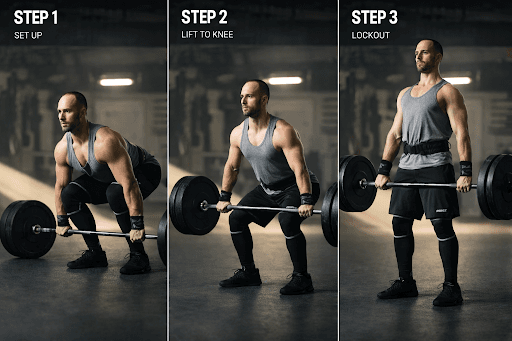
The deadlift begins with the bar over the mid-foot. The athlete sets a braced, neutral spine with hips below the shoulders, grips just outside the legs, and initiates the lift by extending the knees and hips together. The floor-to-knee phase is the most mechanically demanding, requiring positional control as the bar accelerates. Once past the knee, the hips drive to full extension, with the glutes and hamstrings completing the lift. The bar path remains close to vertical throughout.
Sports where the barbell deadlift is most relevant
The deadlift is most valuable in sports requiring maximal force production from static or hip-loaded positions:
- Rowing: Closely replicates the catch-to-drive phase, supporting early stroke force production
- Rugby & American football (forwards/linemen): Develops force in bent-over, resisted positions for scrummaging, rucking, and blocking
- Weightlifting & powerlifting: Foundational for maximal strength and first-pull performance
- Combat sports: Underpins force production in takedowns, lifts, and positional control
- Bobsleigh & skeleton: Supports explosive force application during the push start
- Sprinting & jumping: Indirect transfer by increasing posterior chain strength, setting the force ceiling for sprint and jump performance
How the deadlift develops athletic performance
Posterior chain strength: The deadlift develops the glutes, hamstrings, and spinal erectors. These are key drivers of sprinting, jumping, and hip extension, making it one of the most effective exercises for building maximal force across this system.
Starting strength: It trains force production from a dead stop without elastic contribution from the SSC.
Spinal stability under load: Maintaining a neutral spine under heavy load strengthens the spinal erectors and trunk stabilisers, supporting posture and force transfer in sprinting, jumping, and contact scenarios.
How training can improve your deadlift
For a trained athlete, a focused 8-week deadlift block can realistically produce 8–15% improvement in 1RM, with less trained athletes potentially seeing 15–25% gains given greater room for neural and technical adaptation. Because the deadlift is more directly correlated with absolute muscular strength than with neuromuscular coordination, strength gains tend to transfer immediately and proportionally to performance outputs — particularly in sport contexts where posterior chain force production is the limiting factor.
Hex-bar Deadlift
The hex-bar (trap bar) deadlift is a mechanically efficient and highly transferable strength exercise for athletic development. By positioning the athlete within the bar, it allows a more upright torso and greater knee contribution, creating a movement pattern between a squat and conventional deadlift. This improves load tolerance, ease of learning, and mechanical similarity to jumping and sprinting, while still developing posterior chain strength.
In a velocity-based training context, the hex-bar deadlift is highly effective for developing peak power. Research (e.g. Swinton et al., 2011; Lake et al., 2017) shows it produces greater peak power, force, and velocity than the conventional deadlift at comparable loads, making it a valuable tool across a wide range of athletes.
Overview of the movement
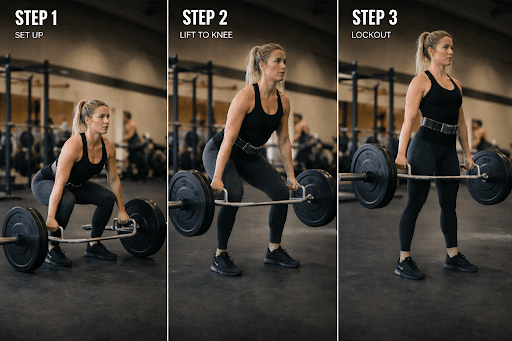
The athlete stands within the hex-bar frame, feet hip-width apart, and grips the handles. The more upright torso position, closer to a squat than a hinge, reduces lumbar stress and increases quadriceps involvement alongside the posterior chain. The lift follows the same phases as a conventional deadlift, from floor to knee and through to full hip extension, but with the load centred over the mid-foot. This reduces hip moment demands and allows heavier loads to be moved at higher velocities.
Sports where the hex-bar deadlift is most relevant
- Sprint and jump sports (athletics, basketball, volleyball): Closely matches vertical jump mechanics, with strong relationships between hex-bar peak power and CMJ performance
- Rugby, American football, and field sports: Widely used as a primary strength exercise and predictor of sprint and contact performance
- Combat sports: Provides high power output with reduced spinal stress, suitable for athletes with mobility limitations
- Swimming starts and cycling: Replicates explosive hip and knee extension from a compressed start position
- Beginner and youth athletes: Safer, more intuitive setup makes it an effective entry point for developing strength and movement competency
How the hex-bar deadlift develops athletic performance
Peak power development: The hex-bar deadlift produces higher peak power than most bilateral exercises, second only to the power clean. Its ability to combine heavier loads with higher velocities targets the region of maximal mechanical power on the force-velocity curve.
Bilateral triple extension strength: Simultaneous hip, knee, and ankle extension under load develops the primary motor pattern underpinning sprinting, jumping, and change of direction.
Reduced spinal loading: A shorter lumbar moment arm lowers spinal stress, allowing heavy strength training with reduced injury risk, particularly during high training volumes or periods of accumulated fatigue.
How training can improve your hex-bar deadlift
For a trained athlete, a focused 8-week hex-bar deadlift block can realistically produce 8–15% improvement in 1RM and meaningful improvements in peak power output at submaximal loads. Less trained athletes may see 15–30% gains given the additional technical learning curve is minimal — the hex-bar deadlift is one of the fastest exercises to develop competence in, meaning strength gains appear earlier and more consistently than in the conventional deadlift.
Back Squat
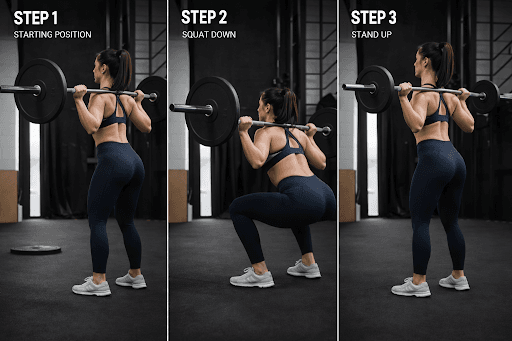
The back squat is the foundational bilateral strength exercise in athletic development and one of the most extensively studied lower-body movements. Performed with a barbell across the upper back, it develops the quadriceps, glutes, hamstrings, calves, and trunk musculature required for stable force production under load. It shows strong associations with jump height, sprint performance, and overall lower-body power, and largely determines an athlete's maximal force capacity.
In a velocity-based training context, bar velocity at submaximal loads provides a reliable indicator of neuromuscular fatigue. The load-velocity relationship is highly consistent, with mean velocity decreasing as load increases, and day-to-day deviations offering a practical measure of athlete readiness.
Overview of the movement
The barbell is positioned across the upper traps (high bar) or rear deltoids (low bar), with feet shoulder-width and toes slightly turned out. The athlete descends by driving the knees out and sitting into the squat while maintaining a braced, upright torso. Depth should reach at least parallel to maximise lower-body contribution. The ascent involves simultaneous hip and knee extension, with the bar path kept over the mid-foot throughout.
Mean velocity (MV) and mean propulsive velocity (MPV) are both used as VBT metrics in the back squat. At maximal loads, MV will be below 0.3 m/s. At 70% 1RM performed with maximal intent, a well-trained athlete should produce MV of 0.6–0.8 m/s. This load-velocity relationship can be used to estimate 1RM without maximal testing and to set daily training loads based on readiness rather than fixed percentages.
Sports where the back squat is most relevant
The back squat is highly relevant across power and team sports, particularly where performance depends on lower-body force production:
- Sprinting and jumping: Strongly linked to acceleration (10–30 m) and jump height
- Rugby, American football, field sports: Supports acceleration, contact, and change of direction; commonly benchmarked (~1.5–2.0 × body weight)
- Basketball and volleyball: Provides the strength base for CMJ and ACMJ
- Weightlifting and powerlifting: Closely associated with maximal strength and Olympic lift performance
- Combat sports: Enhances force production and control in contact
- Rowing and kayaking: Contributes to leg-driven power in the drive phase
Back squat strength is a primary determinant of overall lower-body force capacity.
How the back squat develops athletic performance
Force production ceiling: Maximal squat strength sets the upper limit for force output, directly influencing jump height, sprint speed, and explosive movement capacity.
Bilateral coordination: Trains coordinated activation of the lower limbs and trunk, reinforcing the motor patterns underlying efficient triple extension in athletic tasks.
VBT load-velocity profiling: A stable load-velocity relationship enables readiness monitoring, submaximal 1RM estimation, and load prescription based on daily neuromuscular status, helping avoid unnecessary fatigue.
How training can improve your back squat
For a trained athlete, a focused 8-week squat block can realistically produce 10–20% improvement in 1RM, with less trained athletes potentially seeing 20–35% gains given greater neural adaptation potential. Associated improvements in CMJ height of 3–6 cm and 10 m sprint time of 0.05–0.10 s are realistic outcomes of a strength-focused squat block in athletes who are not at their neuromuscular ceiling.
Front Squat
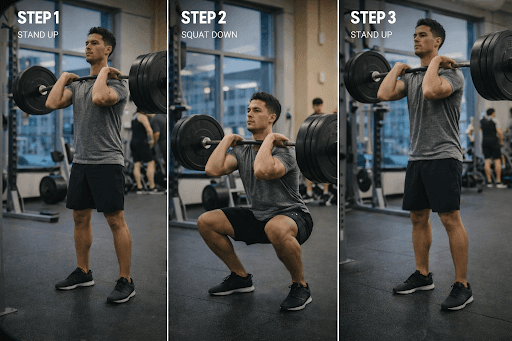
The front squat is a highly sport-specific squat variation, placing greater emphasis on trunk rigidity and knee joint contribution. With the bar positioned on the front of the shoulders, it forces a more upright torso, increasing demand on the quadriceps, upper back, and trunk stabilisers. This posture closely reflects the mechanics of jumping, sprint acceleration, and the power clean catch position.
Although often underutilised due to technical difficulty and discomfort in the rack position, these demands are integral to its value. The mobility and control required to perform the front squat effectively are key indicators of athletic capability, with limitations often reflecting deficits in jumping, landing, and explosive movement patterns that the exercise helps to address.
Overview of the movement
The barbell is supported on the front deltoids with elbows held high to maintain a stable rack position. The athlete descends with a braced, upright torso and knees tracking over the toes to at least parallel depth. Maintaining an upright trunk is essential; excessive forward lean reduces mechanical specificity. The ascent involves driving through the floor while preserving elbow position and trunk alignment to full extension.
In a VBT context, the front squat load-velocity relationship is similar to the back squat but shifted left — athletes typically achieve lower 1RMs in the front squat and produce slightly higher mean velocities at the same relative intensity due to the more favourable biomechanics. This makes front squat velocity profiling a useful complement to back squat monitoring, particularly as a tool for identifying anterior chain weaknesses in athletes whose front squat velocity profile differs substantially from their back squat profile.
Sports where the front squat is most relevant
- Weightlifting: Directly specific to the clean catch; performance is closely determined by front squat strength and control
- Jumping sports (basketball, volleyball, high jump): Mirrors CMJ mechanics, supporting jump technique and height through quad dominance and trunk rigidity
- Sprinting and acceleration: Develops anterior chain strength and trunk stability required during deep knee flexion in early acceleration
- Rugby and American football: Enhances posture and force transfer in contact positions
- Gymnastics and diving: Improves trunk stability and positional control under load
In more hip-dominant sports (e.g. rowing, powerlifting, bobsleigh), the front squat serves as a secondary strength exercise rather than the primary bilateral movement.
How the front squat develops athletic performance
Anterior chain emphasis: The front squat places greater load on the quadriceps than other squat variations, supporting jumping, landing, and sprint acceleration. Addressing quad weakness improves knee alignment, trunk position, and jump efficiency.
Trunk rigidity under load: Maintaining high elbows requires strong thoracic extension and trunk stiffness, enhancing force transfer between lower and upper body in explosive movements.
Mobility and positional control: Front squat performance reflects ankle, hip, and thoracic mobility. Improvements typically translate to better landing mechanics, squat depth, and Olympic lift positions.
How training can improve your front squat
For a trained athlete, a focused 8-week front squat block can realistically produce 8–16% improvement in 1RM, with the most significant gains coming from athletes whose front squat is disproportionately weaker than their back squat (a front-to-back squat ratio below 0.75). Associated improvements in CMJ height of 2–5 cm are consistently documented in research linking anterior chain strength gains to jump performance improvement.
Bench Press
The bench press is widely considered the primary upper-body strength measurement in strength & conditioning. Performed supine with a barbell lowered to the chest and pressed to full extension, it develops the pectorals, anterior deltoids, and triceps under high load. Beyond general strength, it contributes to contact force, upper-body power, and effective force transfer from trunk to arms in actions such as throwing, blocking, and striking.
In a velocity-based training context, the bench press demonstrates a well-defined load-velocity relationship, supporting readiness monitoring, submaximal 1RM estimation, and velocity-based load prescription. Training with maximal intent at submaximal loads also enhances upper-body power and rate of force development more effectively than controlled lifting at the same intensities.
Overview of the movement
The athlete lies supine with feet flat, a natural lumbar arch, and the bar positioned over the mid-chest. Grip width is typically 1.5–2× shoulder width, with elbows slightly tucked. The bar is lowered under control (2–3 seconds) to the chest, then pressed with maximal intent. In a VBT context, concentric velocity should be maximised regardless of load. The bar path follows a slight arc from the chest toward the shoulders at lockout.
Mean velocity (MV) and mean propulsive velocity (MPV) are the primary VBT metrics. At maximal loads (95–100% 1RM), MV is typically below 0.17 m/s. At 70% 1RM with maximal intent, well-trained athletes produce MV of 0.65–0.85 m/s. This load-velocity relationship is consistent enough across populations that a two-point velocity profile (MV at two different loads) can estimate 1RM with acceptable accuracy — removing the need for maximal testing in most monitoring contexts.
Velocity zones (bench press)
| Zone | Load (% 1RM) | Target MV | Training goal |
|---|---|---|---|
| Max Strength | 85–100% | < 0.5 m/s | Force production ceiling |
| Strength-Speed | 70–85% | 0.5–0.75 m/s | Force at moderate velocity |
| Power Zone | 50–70% | 0.75–1.0 m/s | Peak power output |
| Speed-Strength | 30–50% | 1.0–1.3 m/s | Rate of force development |
| Max Speed | < 30% | > 1.3 m/s | Peak bar velocity / neural drive |
Sports where the bench press is most relevant
- American football (linemen): Key for blocking and pass-rushing; a standard performance metric
- Rugby (forwards): Supports scrum force, tackling, and ruck positioning
- Throwing events: Contributes to release velocity, particularly in shot put
- Combat sports: Develops striking power and upper-body force application
- Swimming: Assists upper-body force production in sprint strokes
- Basketball and volleyball: Primarily used as a neuromuscular readiness monitoring tool
In sports with minimal upper-body pressing demands (e.g. rowing, cycling), it serves a secondary role for structural balance rather than performance development.
How the bench press develops athletic performance
Upper-body horizontal force: The bench press develops the pectorals, anterior deltoids, and triceps, supporting force production in blocking, striking, throwing, and swimming.
Upper-body rate of force development (RFD): Performed with maximal intent at submaximal loads (≈40–70% 1RM), it enhances rapid force application, relevant to punch speed, blocking reactions, and explosive arm actions.
Trunk-to-arm force transfer: A stable setup requires effective force transmission from the trunk to the arms, improving throwing power and upper-body contact performance.
How training can improve your bench press
For a trained athlete, a focused 8-week bench press block can realistically produce 5–12% improvement in 1RM and 0.05–0.15 m/s improvement in MV at 70% 1RM with maximal intent training. Less trained athletes can expect 12–20% 1RM gains given greater neural adaptation potential. The velocity-focused training approach (maximal intent at 40–70% 1RM) produces meaningful improvements in upper-body power output that are not achieved by purely strength-focused programmes — athletes who add speed bench work to an existing heavy programme consistently show greater RFD improvement than those who only train heavy.